End-Grain Cutting Board
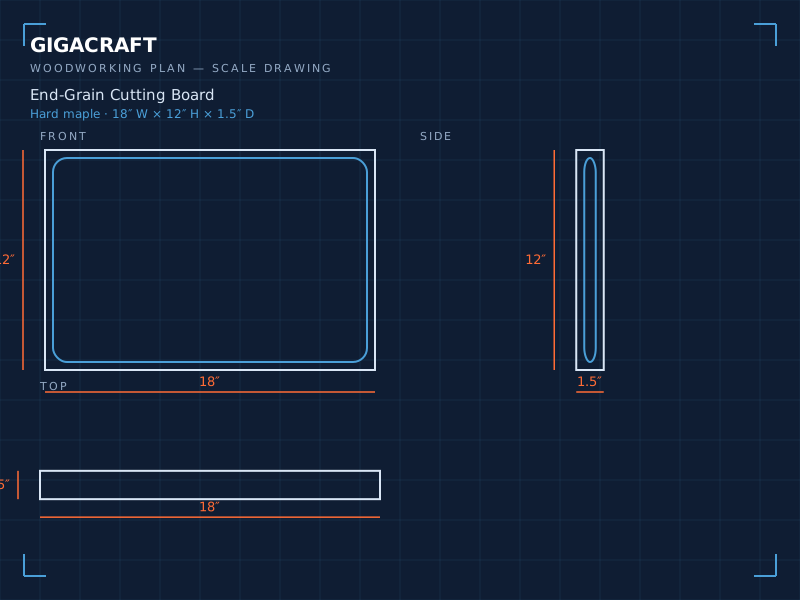
A durable butcher-style board glued from maple strips with a juice groove and finger holds. End grain is gentle on knives.
Difficulty Beginner Category Workshop Time 120 min Cost $25 Primary wood Hard maple
01Materials
- Hard maple, 2 board feet
- Food-safe wood glue (Titebond III)
- Mineral oil
- Beeswax
- Sandpaper up to 400 grit
02Cut List
| # | Part | Dimension | Note |
|---|---|---|---|
| 01 | Maple strips ripped to 1.5 in wide, then crosscut to 12 in lengths | ||
| 02 | Final board planed to 1.5 in thick, 12 × 18 in |
03Tools
- Table saw
- Planer or drum sander
- Clamps
- Router with roundover bit
- Random-orbit sander
04Build Steps
- Mill the strips. Rip straight-grained maple into even strips, then glue the first panel face-to-face and clamp until set.
- Crosscut and flip. Crosscut the panel into blocks, rotate each 90 degrees so the end grain faces up, and glue again into the final panel.
- Flatten and square. Plane or drum-sand the board flat and square the edges to final size.
- Add the groove and holds. Rout a shallow juice groove around the face and a finger hold under each end.
- Sand and season. Sand through the grits, then flood with mineral oil and finish with a beeswax-oil blend. Re-oil monthly.
Safety First
- Never route a board you cannot hold firmly; use a router mat or clamps.
- Food-safe glue and oil only — do not use shop glue with dyes or fungicide.
05Pro Tips
- Alternate grain direction of the strips to resist cupping.
- Raise the grain with water and sand again for a smoother finish.